Two countries. One language. Four centuries of culinary exchange that started with a handful of Spanish conquistadors landing on Caribbean shores and accidentally introducing chickens, rice, and garlic to a continent already obsessed with potatoes and corn. Now they’re both heading to the 2026 World Cup, and honestly, their food tells the same story as their football: Spain brings the technical precision, Colombia brings the soul, and somehow when they mix, you get something better than the sum of its parts.
Spain won the World Cup in 2010 with a midfield that passed the ball like it was on a conveyor belt — tiki-taka, they called it, a Basque word that roughly translates to “let’s have a go.” They’ve since added European Championship glory in 2012, 2024, and a Women’s World Cup in 2023. Their squad for 2026? Lamine Yamal (who is 18 and plays like he’s been doing this for forty years), Rodri (the metronome), Pedri (who once looked at a football like it owed him money), and Mikel Merino at Arsenal. Luis de la Fuente picked a squad that’s equal parts experience and terrifying teenage talent.
Colombia, meanwhile, have been on a different journey. They missed the 2022 World Cup entirely — a shock that sent the whole country into a collective sulk that lasted about six months. But they’re back for 2026, captained by James Rodriguez, the man who scored five goals in a single World Cup knockout round in 2014 and has been living off that reputation ever since (fair enough, honestly). Luis Diaz brings the Liverpool pace, and Colombia’s best World Cup finish was fourth in 1962, back when the tournament had 16 teams and you could actually argue that was a decent run.
Similarities
- Spanish language. This isn’t just a football blog — the shared language means centuries of recipe exchange. Colombian Spanish cuisine literally evolved from Spanish colonial cooking, then went and did its own thing with indigenous and African influences.
- Football-obsessed populations. Both countries stop everything when their national team plays. In Spain it’s a siesta interrupted by a goal celebration. In Colombia it’s a whole city evacuating the streets to celebrate.
- Passion for potatoes. Spain has its patatas bravas. Colombia has three hundred varieties of native potato, and ajiaco soup is basically a love letter to the tuber. Spain grew potatoes after the Spanish Armada brought them from South America, which is the great irony — Colombia’s potato eventually became Spain’s national side dish.
- Rice as a staple. Spain’s paella and Colombia’s arroz con pollo both build a meal around rice, but take it in completely different directions.
Differences
- Climate and ingredients. Spain is Mediterranean — olive oil, garlic, tomatoes, seafood, jamón. Colombia is tropical mountain country — plantains, corn, avocados, tropical fruits, and spices you won’t find in a British supermarket without a loyalty card.
- Spice level. Spanish food uses paprika and pimentón for warmth. Colombian food uses ají, guiso, and a range of chillies that would make a Spanish grandmother weep. Colombian ajiaco has guasca — a herb that tastes like earth and determination — which has no Spanish equivalent.
- Street food culture. Spain has pinchos and tortilla de patata from every corner bar in the country. Colombia has arepas, empanadas, and bandeja paisa — a plate so large and ambitious it comes with a side of existential questioning about portion sizes.
- Coffee. Both drink it. Colombia grows some of the best. Spain puts so much milk in theirs that it’s basically a hot chocolate that’s been told to get a grip.
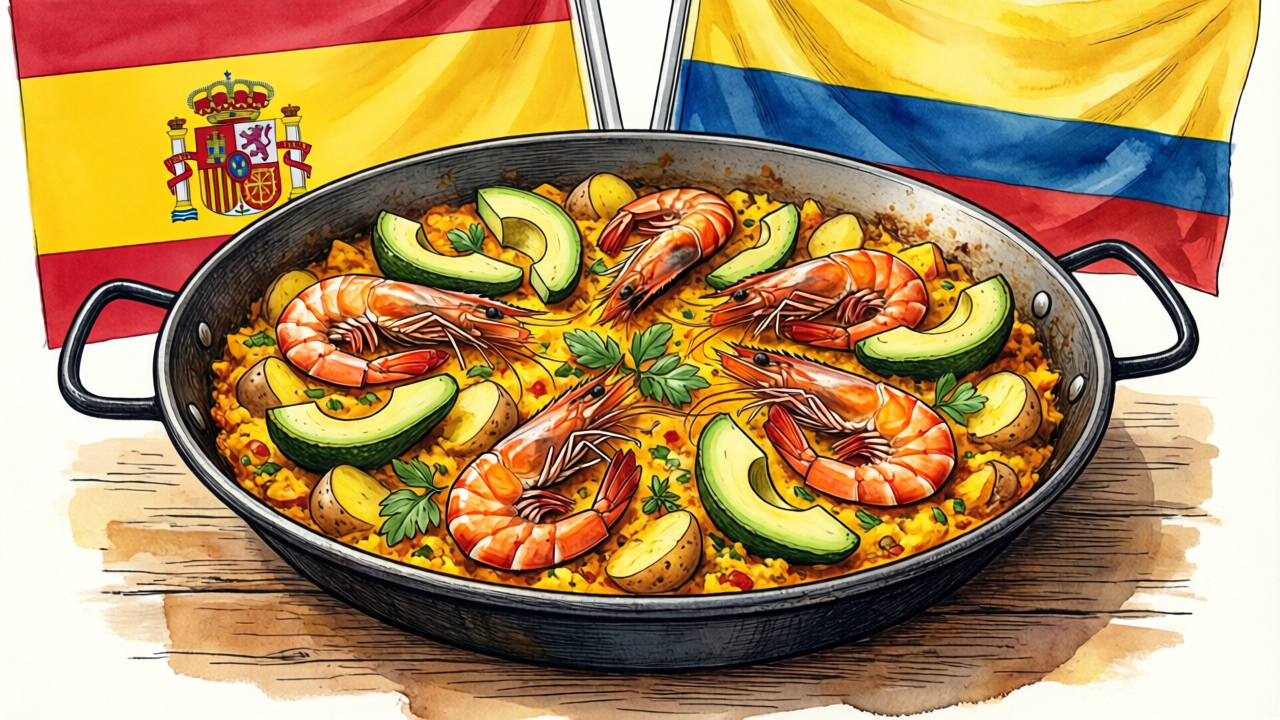
The Fusion: Paella-Ajiaco (The Best of Both Worlds)
Here’s the thing about fusion food — done badly, it’s a mess of cultural appropriation and confused flavour profiles. Done well, it’s a celebration of what happens when two great culinary traditions have a chat and decide to share notes. This recipe takes the rice-and-seafood foundation of Spanish paella and the chicken-and-potato comfort of Colombian ajiaco soup, and merges them into something that would make both countries nod in reluctant respect.
The key insight: paella is about the socarrat — the crispy rice crust at the bottom of the pan. Ajiaco is about the broth — slow-simmered, herb-heavy, deeply comforting. So we build a risotto-style rice dish that has the depth of ajiaco broth with the texture of paella rice, finished with the tropical brightness that makes Colombian cooking sing.
Ingredients
- 300g bomba or arborio rice (Spanish paella rice, or whatever you can get — this isn’t a fight)
- 400g chicken thighs, cubed
- 200g prawns, peeled
- 100g mussels, cleaned
- 3 potatoes (any variety), cut into chunks
- 1 large onion, finely chopped
- 4 garlic cloves, minced
- 1 red chilli, finely chopped (this is where Colombia speaks)
- 1 tbsp smoked paprika (pimentón de la Vera if you’re fancy)
- 1 tbsp cumin
- 1 cup frozen corn kernels
- 1 litre chicken stock
- 200ml dry white wine
- 1 avocado, sliced (essential — this is Colombian territory now)
- Fresh cilantro (coriander), chopped
- Lime wedges
- Olive oil
- Salt and black pepper
Method
- Start the broth base: Heat olive oil in a wide pan (paella pan if you have one, large frying pan if you don’t). Sauté the onion for 5 minutes until soft. Add the garlic and chilli, cook for another minute.
- Build the flavour: Stir in the smoked paprika and cumin — toast them for 30 seconds until fragrant. This is the moment where Spain and Colombia shake hands over the spice rack.
- Chicken time: Add the chicken thighs, brown them for 5-6 minutes. Pour in the white wine and let it reduce by half. This deglazes the pan and adds that Spanish acidity.
- Add stock and potatoes: Pour in the chicken stock, add the potato chunks, and bring to a simmer. Cook for 10 minutes — the potatoes should be half-done.
- Rice goes in: Add the rice, stir once, and then don’t stir it again. This is non-negotiable paella discipline. Let the rice absorb the liquid for 12 minutes. The broth, now full of potato and chicken flavour, is essentially ajiaco in liquid form being absorbed by Spanish rice.
- Seafood layer: Tuck the prawns and mussels into the rice. Scatter the corn on top. Cover the pan and let it steam for 5 minutes until the seafood is cooked.
- The socarrat: Crank the heat up for 2 minutes at the end to get that crispy rice crust at the bottom. This is the Spanish signature move — the bit that separates paella from any other rice dish.
- Rest and serve: Remove from heat, cover with a clean tea towel, and let it rest for 5 minutes. The residual steam finishes the cooking. Serve topped with sliced avocado, a generous handful of cilantro, and lime wedges on the side. The avocado and lime are the Colombian goodbye — bright, tropical, and impossible to argue with.
Serves 4. Best eaten with a bottle of something that both countries would approve of — a Spanish albariño or a Colombian craft lager (yes, Colombia makes craft beer now, and it’s actually good). The socarrat at the bottom of the pan is the prize — scrape it up, share it, and argue about whether this is more Spanish or more Colombian. The answer is: it doesn’t matter. It’s both, and that’s the point.